



[토마스의 그림이야기 56] 호녀(Tiger Woman) _ 최민화 작가
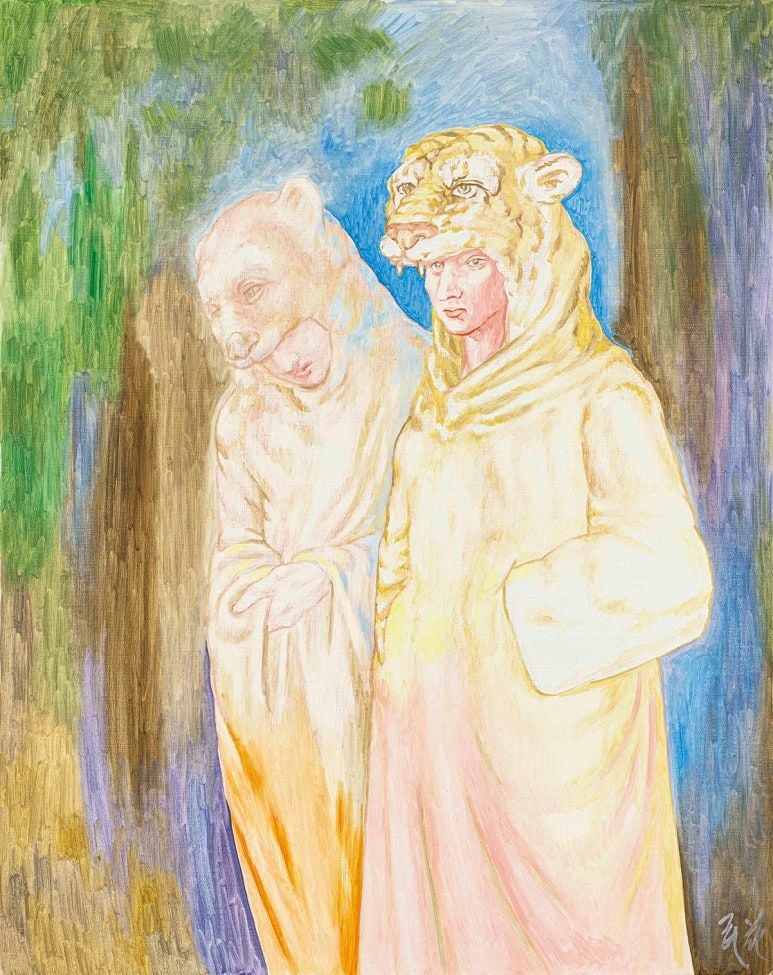
이 작품은 환인(천신)의 아들 환웅이 태백산 신단수 아래로 내려와 신시를 열고, 곰에서 변한 웅녀와 혼인하여 단군왕검을 낳았다는 단군신화를 연상시키는 그림으로, 1980년대 한국 민중미술을 대표하는 최민화(崔民華) 작가의 〈호녀(Tiger Woman)〉이다.
그림에는 인간과 동물, 현실과 신화의 경계가 겹쳐지는 장면이 서정적으로 펼쳐진다. 오른쪽에는 호랑이 가면(혹은 머리)을 쓴 여성이, 왼쪽에는 곰의 가면을 쓴 남성으로 추정되는 인물이 나란히 서 있다. 두 인물 모두 인간의 신체를 지녔지만 얼굴과 정체성은 명확하지 않다. 특히 왼쪽 인물은 윤곽이 흐릿하게 처리되어, 마치 사라지거나 다른 차원에서 겹쳐진 존재처럼 보인다.
이러한 흐릿함은 우연이 아니라 변신의 중간 상태, 혹은 정체성이 아직 고정되지 않은 존재를 암시한다. 여인이 호랑이로 변해가는 순간일 수도 있고, 동물의 영혼이 인간의 몸에 잠시 깃든 상태로도 읽힌다. 이는 단군신화에서 곰이 인간으로 변신하는 서사와 자연스럽게 연결된다.
전체적인 색채와 분위기는 부드럽고 몽환적이며, 배경은 특정 장소라기보다 신화적 공간, 즉 현실과 무의식의 경계로 인식된다. 여기서 호랑이는 수호자이자 두려움의 대상이고, 곰은 변신과 탄생의 상징이다. 이 작품은 존재가 다른 존재로 넘어가는 문턱의 순간을 시각화한다.
그러나 이 그림에서 여성은 시험을 견디는 수동적 존재가 아니다. 이미 자신의 힘을 몸에 두른 주체적 존재로 등장한다. 최민화는 단군신화의 ‘변신’ 개념을 차용해, 여성을 길들여진 존재가 아니라 자연·본능·기억·야성을 스스로 끌어안은 존재로 재해석한다. 그녀는 공격적이지 않지만 위엄이 있으며, 말하지 않지만 분명한 시선을 지닌 인물로 묘사된다.
최민화(본명 최철환)는 1980년대 한국 민중미술을 대표하는 화가로, ‘민중은 꽃이다’라는 뜻의 예명을 1982년부터 사용하고 있다. 홍익대학교 미술대학을 졸업한 그는 수십 차례의 개인전과 다수의 단체전을 통해, 평범한 민중의 삶과 한국의 고대 신화·역사를 현실적이면서도 독창적인 구상 회화로 꾸준히 풀어내고 있다.
Tiger Woman by Choi Minhwa (崔民華)
This work recalls the Korean foundation myth of Dangun, in which Hwanung, the son of Hwanin (the Heavenly God), descends beneath the sacred sandalwood tree on Mount Taebaek to establish the Divine City (Sinsi), marries Ungnyeo — the woman transformed from a bear — and fathers Dangun Wanggeom. The painting is Tiger Woman by Choi Minhwa (崔民華), a leading figure of Korean Minjung (People’s) Art in the 1980s.
In the painting, a lyrical scene unfolds in which the boundaries between human and animal, reality and myth, overlap. On the right stands a woman wearing a tiger mask (or tiger’s head), while on the left is a figure presumed to be male, wearing a bear mask. Both figures possess human bodies, yet their faces and identities remain ambiguous. In particular, the left figure is rendered with blurred contours, appearing as though fading away or overlapping with another existence from a different dimension.
This blurring is not accidental. It suggests an intermediate state of transformation, or a being whose identity has not yet fully solidified. It may depict the moment a woman is transforming into a tiger, or a moment in which the spirit of an animal temporarily inhabits a human body. Such imagery naturally connects to the Dangun myth, in which a bear transforms into a human woman.
The overall palette and atmosphere are soft and dreamlike, and the background is perceived not as a specific location but as a mythic space — a threshold between reality and the unconscious. Here, the tiger symbolizes both a guardian and an object of fear, while the bear represents transformation and birth. The work visualizes the liminal moment in which one form of being crosses over into another.
Yet the woman in this painting is not a passive figure enduring a trial. She appears instead as a self-possessed subject who already embodies her own power. By borrowing the concept of transformation from the Dangun myth, Choi Minhwa reinterprets womanhood not as something to be tamed, but as an existence that actively embraces nature, instinct, memory, and wildness. She is depicted as non-aggressive yet dignified — silent, yet holding a clear and unwavering gaze.
Choi Minhwa (born Choi Cheol-hwan) is a representative painter of Korean Minjung Art in the 1980s. He has used the artist name “Minhwa,” meaning “the people are flowers,” since 1982. A graduate of Hongik University College of Fine Arts, he has held dozens of solo exhibitions and participated in numerous group shows, consistently presenting a body of work that portrays the lives of ordinary people alongside Korea’s ancient myths and history through a realistic yet distinctly original figurative style.
