



[토마스의 그림이야기 36] 크리스마스이브 by AI
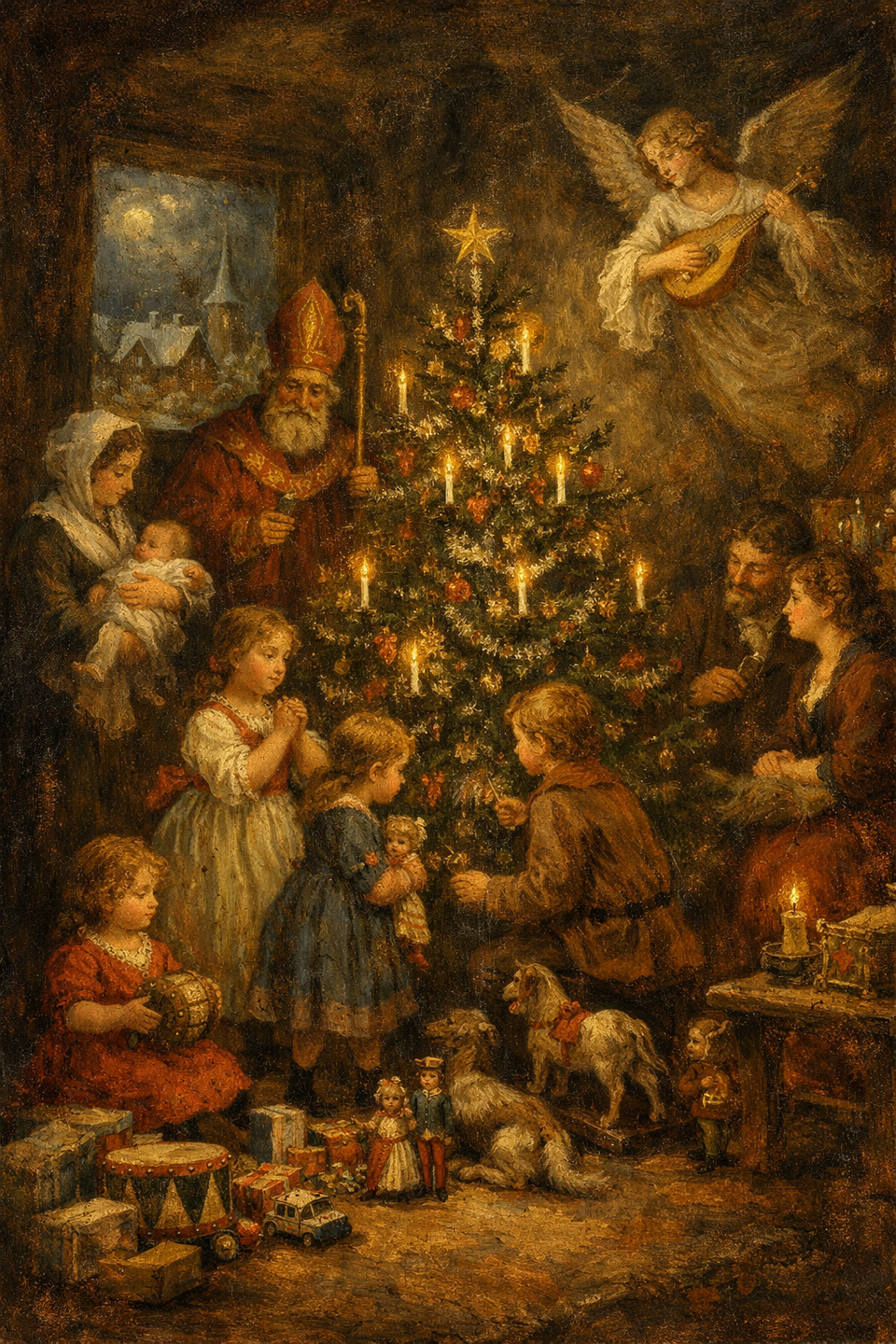
이 작품은 필자가 AI 이미지 생성 도구(DALL·E 계열)를 사용하여 몇 가지 프롬프트로 만든 '크리스마스이브'라는 제목의 가상(창작) 회화이다. 크리스마스의 의미와 가정 그리고 오늘날 크리스마스가 있게 한 성 니콜라스우스 등을 소재로 19세기 유럽 회화 스타일을 충실히 모사하여 만든 작품이다.
AI가 주문에 따라 만들었지만 19세기 유럽 회화풍의 크리스마스이브 장면을 따뜻하고 서정적으로 담아낸 작품으로 전체적으로 가족, 신앙, 나눔, 희망이라는 크리스마스의 핵심 가치를 한 화면에 응축하고 있다. 중앙의 촛불이 켜진 크리스마스트리는 빛과 희망, 그리고 그리스도의 타생을 상징하며, 트리 뒤 왼편의 오늘날 산타클로스의 기원인 성 니콜라우스(St. Nicholas)는 아이들에게 선물을 나누는 모습은 자비와 나눔의 정신을 의미한다.
또한 오른쪽 위에서 르네상스풍 악기를 연주하는 천사는 하늘의 축복과 신성한 기쁨을 상징으로 크리스마스가 단순한 축제가 아닌, 영적인 날로 인식하게 만드는 장치이기도 하다. 아이들이 장난감과 선물을 바라보는 모습은 순수한 기쁨과 기대를 표현한다. 어른들은 아이들을 지켜보며 미소 짓고 있어, 가족 공동체의 따뜻함이 강조되고 있다. ''비록 AI가 만든 작품이지만 이 그림은 단순히 “크리스마스 풍경”을 그린 것이 아니라, 이 그림은 가족이 함께하는 시간의 소중함, 나눔과 신앙이 살아 있는 공동체, 어둠 속에서도 빛나는 희망을 이야기하고 있다. .
AI의 발전은 가히 무서울 정도로 빠르게 발전하고 있다. 대덕의 모 국책연구소에서 로봇 개발을 주도했던 한 과학자로서도 AI가 이렇게 빠르게 발전하리라고는 상상을 하지 못했다. AI는 1년에 100배 정도의 성능을 향상시키고 있으며, 아마도 머지않은 시기에 인류를 위협하는 대상이 될 것임이 분명하다고 전문가들은 말한다.
2016년 알파고의 출시와 함께 AI의 가능성을 보이 드니 2022년 11월 쳇GPT(ChatGPT)의 등장과 함께 누구나 사용이 가능한 AI를 우리에게 선보였다. 이렇게 시작한 AI가 불과 2~3년 만에 “AI가 인간의 직관과 창의 영역까지 넘을 수 있다"라는 가능성을 보이게 된 것이다.
AI의 보급 속도는 스마트폰 보급 속도보다도, 인터넷 확산 속도보다도 훨씬 가파르다. 다시 말해 조만간 'AI 맹(AI를 이해하지 못하고 사용하지 못하는 사람)'이라면 이 세상에 적응하며 살아가기 힘들어진다는 이야기이다. 현재 생성형 AI라는 이름으로 AI는 산업분야뿐만 아니라 우리의 생활에까지 깊숙이 사용되고 있다. 멀티 모달 AI, 에이전트 AI 등의 출현으로 AI는 수십만 명의 지식을 단숨에 흡수하며 'AI가 AI 개발을 돕는 단계'로 진입하고 있다.
그래서 결론은 이 세대 또한 미래에 살아남기 위해서는 반드시 AI를 알아야 한다는 것이다. 전문가가 되라는 이야기가 아니라 AI가 우리에게 어떤 영향을 미치는지, AI 시대 우리는 어떻게 대처해나가야 하는지에 대해서 알아야 한다는 것이다.
Christmas Eve - AI
This work is a virtual (creative) painting titled “Christmas Eve,” created by the author using an AI image generation tool (from the DALL·E family) with several prompts. Drawing on themes such as the meaning of Christmas, family, and Saint Nicholas—who gave rise to the modern celebration of Christmas—the piece faithfully emulates the style of 19th-century European painting.
Although it was produced by AI according to specific instructions, the artwork warmly and poetically captures a Christmas Eve scene in the style of 19th-century European art. Overall, it condenses the core values of Christmas—family, faith, sharing, and hope—into a single image. At the center, a Christmas tree lit by candles symbolizes light, hope, and the birth of Christ. Behind the tree on the left, Saint Nicholas—the origin of today’s Santa Claus—is depicted distributing gifts to children, representing the spirit of compassion and generosity.
In addition, an angel playing a Renaissance-style instrument in the upper right symbolizes heavenly blessings and sacred joy, serving as a visual device that frames Christmas not merely as a festive celebration but as a deeply spiritual day. The children gazing at their toys and gifts express pure joy and anticipation, while the adults smile as they watch over them, emphasizing the warmth of the family community. Although this work was created by AI, it is not simply a depiction of a “Christmas scene.” Rather, it tells a story about the preciousness of time spent together as a family, a community alive with sharing and faith, and hope that shines even in darkness.
The development of AI is advancing at a truly astonishing pace. Even as a scientist who once led robot development at a national research institute, I never imagined that AI would progress this rapidly. Experts note that AI is improving its performance by roughly one hundred times each year, and it is becoming increasingly clear that it may pose a threat to humanity in the not-too-distant future.
With the release of AlphaGo in 2016, AI demonstrated its potential, and in November 2022, the emergence of ChatGPT introduced AI that anyone could use. In just two to three years, AI has begun to show the possibility of surpassing human intuition and creativity.
The speed at which AI is spreading far exceeds that of smartphones or even the internet. In other words, those who are “AI-illiterate”—unable to understand or use AI—may soon find it difficult to adapt and survive in this world. Today, under the name of generative AI, AI is being deeply integrated not only into industrial fields but also into our daily lives. With the emergence of multimodal AI and agent AI, AI is rapidly absorbing the knowledge of hundreds of thousands of people at once and entering a stage where “AI helps develop AI.”
The conclusion, therefore, is clear: for this generation to survive in the future, understanding AI is essential. This does not mean everyone must become an expert, but rather that we need to understand how AI affects us and how we should respond in the age of AI.
