



[토마스의 그림이야기 44] 양지역 _ 허만갑
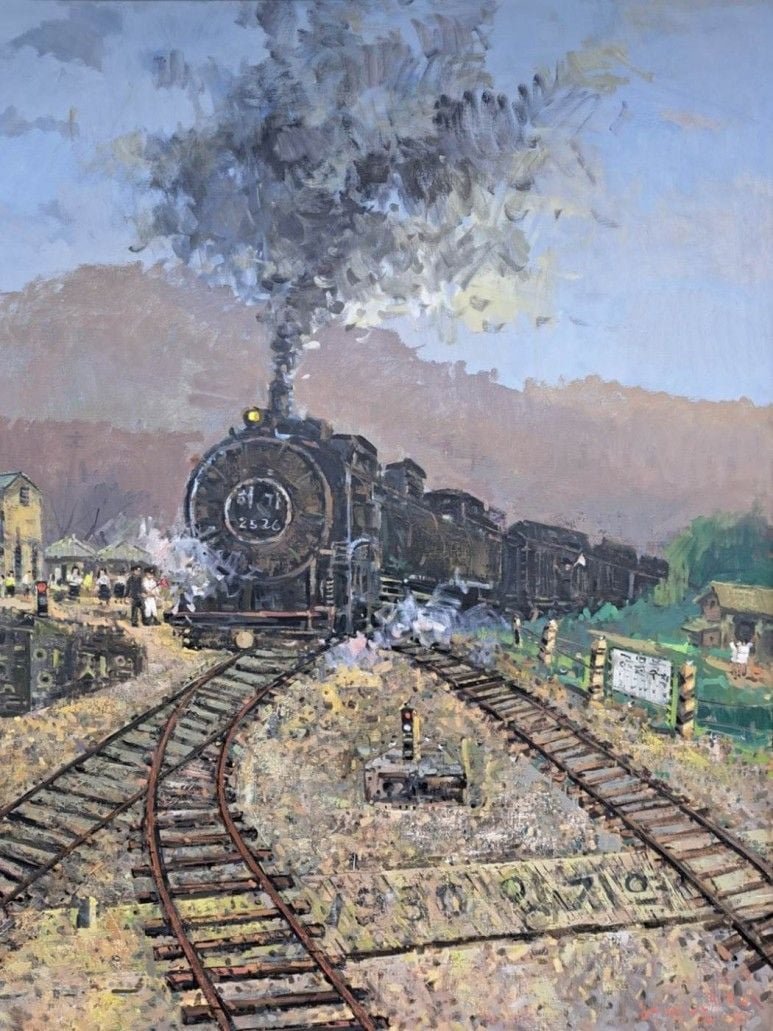
지금은 사라지고 없지만 일제 강점기에 곡창지대인 여주, 이천, 용이 지역에서 생산되는 쌀을 수탈하여 일본으로 보내기 위한 목적으로 수원-여주 간 철도인 수려선이 있었다. 일제 강점기인 1930년 12월에 조선경동철도주식회사가 협궤철도 부설되었고, 1942년에 수인선은 조선철도에 양도되어 수인선(수원 인천 간)을 합쳐 경동선(京東線)이라 하였다가 광복 이후 사철 국유화 정책에 따라 교통부 철도국 소유로 변경되었다.
경동선은 1971년 영동고속도로가 개통되면서 철도 교통 수용가 급감하여 1972년 폐선 되었고, 용인시 양지면 양지리에 있던 양지역 또한 폐쇄되었고 지금은 야적장과 센트랄타워라는 건물이 들어서 있다.
이 작품, '양지역'은 50년 용인을 그려온 풍경화가 허만갑 화백의 그림이다. 그는 “한 오십 년 이 땅의 풍경을 담아오다 보니 이제는 제가 마치 고향의 옛집 같은 존재가 되어 간다고 말한다.” 그래서인지 허만갑 작가에게 지역에 있는 돌담, 슬레이트 함석지붕, 방앗간 그 하나하나가 그 자체가 ‘예술’처럼 느껴지기도 하고 작품의 소재가 되는 풍경이 되기도 한다고 한다.
허만갑 화백은 자신의 풍경화에 대해 "언제 가는 운무(雲霧)처럼 사라질 것들을 필사적으로 붙잡아 두려는 몸부림일 수도 있고, 자연과 같이 호흡하려는 황홀한 혼연 일치된 구도자의 마음"일 수도 있다고 말한다.
50여 년 이곳의 풍경을 그려온 허만갑 화백은 용인에 대한 특별한 애착이 있다. 그는 용인이 세계에서 가장 아름다운 빛을 지닌 도시라고 외친다. 그는 “나의 그림은 용인이며 용인의 마음이며 용인의 역사입니다. 동백의 설경, 지곡동 풍광, 맹리, 사암리, 모현 갈담리, 초부리가 내 영혼처럼 거기 피어 있습니다.”라고 말한다. 용인에서 태어나 용인을 그리는 허만갑에게 용인은 성장과 추억과 또 작품의 탄생을 가져온 놀이터이기도 한데, 그래서 ‘용인이 좀 더 아름답고 인간적인 삶의 터전으로 나아갈 수 있도록 개발이 전통과 자연의 조화를 이루는 지혜를 발휘해야 한다”라며 만나는 사람마다 용인에 대한 애정의 당부를 하고 있기도 하다.
허만갑 화백은 50년간의 애정으로 그려온 풍경들을 집대성한 전자 도록집 '그리운 풍경'을 2024년 1월 발간했다. 특히나 그의 풍경 속 용인은 하나의 역사이기도 하다. 필자는 허만갑 화백의 전자 도록집(e-book) 발간을 준비를 하며 "언제 가는 운무(雲霧) 처럼 사라질 것들을 필사적으로 붙잡아 두려는 몸부림일 수도 있고, 자연과 같이 호흡하려는 황홀한 혼연 일치된 구도자의 마음일 수도 있다"라고 말하는 허만갑 화백의 독백에 허 화백의 진심 어린 용인 사랑이 느껴져 눈시울이 붉어지기도 했다.
Yangji Station
Although it no longer exists today, during the Japanese colonial period there was the Suryeo Line, a railway running between Suwon and Yeoju. It was built for the purpose of exploiting rice produced in the fertile granary regions of Yeoju, Icheon, and Yongin and transporting it to Japan. In December 1930, during the colonial era, the Joseon Gyeongdong Railway Company constructed this narrow-gauge railway. In 1942, the Suryeo Line was transferred to Joseon Railway and merged with the Suin Line (Suwon–Incheon), forming what was known as the Gyeongdong Line (京東線). After Korea’s liberation, under the nationalization policy for private railways, it came under the ownership of the Railway Bureau of the Ministry of Transportation.
With the opening of the Yeongdong Expressway in 1971, railway usage declined sharply, and the Gyeongdong Line was officially closed in 1972. Yangji Station, located in Yangji-ri, Yangji-myeon, Yongin City, was also shut down. Today, the site is occupied by a storage yard and a building known as Central Tower.
The artwork “Yangji Station” is a painting by Heo Man-gap, a landscape painter who has depicted the scenery of Yongin for over fifty years. He once said, “After capturing the landscapes of this land for some fifty years, I feel as though I myself am gradually becoming like an old ancestral home of my hometown.” Perhaps for this reason, to Heo Man-gap, every stone wall, slate roof, and small rice mill in the region feels like a work of art in itself and naturally becomes a subject of his paintings.
Regarding his landscapes, Heo Man-gap explains that they may be “a desperate attempt to hold on to things that will disappear like passing clouds and mist,” or “the mind of a seeker who wishes to breathe in unison with nature, reaching a state of ecstatic oneness.”
Having painted the scenery of this place for more than half a century, Heo Man-gap holds a deep and special affection for Yongin. He proclaims that Yongin is a city blessed with the most beautiful light in the world. He says, “My paintings are Yongin—its heart and its history. The snowy camellia landscapes, the scenery of Jigok-dong, Maeng-ri, Saam-ri, Mohyeon Galdam-ri, and Choburi all bloom there like my very soul.”
Born in Yongin and devoted to painting Yongin, the city has been for him a playground of growth and memories, as well as the birthplace of his art. For this reason, he often urges those he meets to cherish Yongin, emphasizing that “development must exercise wisdom so that it harmonizes with tradition and nature, allowing Yongin to grow into a more beautiful and humane place to live.”
This time, with fifty years of devotion, Heo Man-gap plans to publish an electronic exhibition catalog (e-book) titled “Longed-for Landscapes” (scheduled for January 2024), a comprehensive collection of the scenery he has painted over the decades. In particular, the Yongin that appears in his landscapes is, in itself, a form of history.
While preparing this e-book, the author found their eyes welling up upon reading Heo Man-gap’s reflection—that his paintings may be a desperate struggle to hold on to things destined to vanish like drifting clouds and mist, or the heartfelt meditation of one seeking unity with nature—feeling deeply the artist’s sincere love for Yongin.
