



[토마스의 그림이야기 42] 붉은 말들 _프란츠 마르크
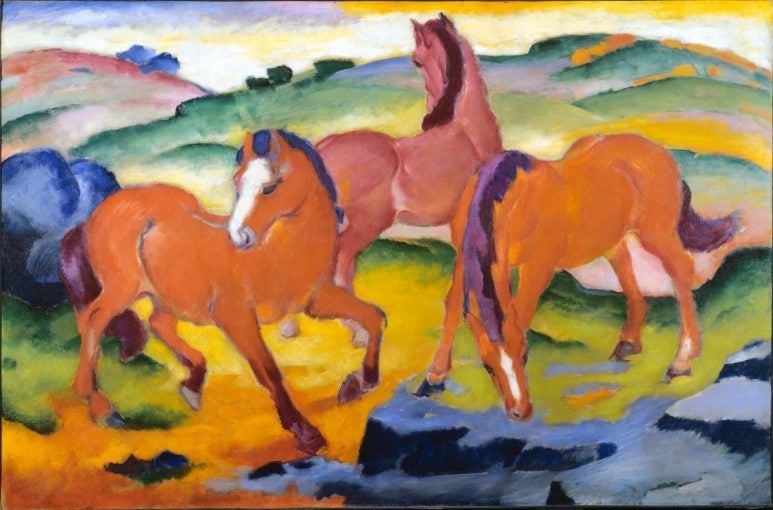
이 작품은 청기사파의 창시자 중 한 명인 프란츠 마르크(Franz Marc, 1880–1916)의 '붉은 말들'이다. 붉은 말 세 마리가 언덕 위에서 서로 기대거나 고개를 숙인 채 배치되어 있다. 말의 형태는 현실적 묘사라기보다 단순화되고 율동적인 곡선으로 구성되며, 배경의 산과 하늘 역시 기하학적 색면으로 분해되어 있고, 전체 화면은 리듬감 있는 색의 흐름으로 하나의 유기체처럼 느껴진다.
독일의 표현주의 화가이자 청기사파(Der Blaue Reiter) 화가인 프란츠 마르크는 인간 사회를 타락한 세계로 보았고, 동물을 더 순수하고 진실한 존재로 여겼다. 마르크는 힘, 자유, 영혼 움직임의 상징인 말 중에서도 붉은 말이 자연의 생명 에너지 그 자체로 보았다.
자연 속 동물, 색채를 통한 영혼과 감정을 표현한 이 작품, '붉은 말들'은 단순한 동물 화가 아니라 “자연과 영혼의 합일”을 그린 정신적 풍경화에 가깝다고 볼 수 있다. '자연과 영혼의 합일”을 그린 마르크에게 색은 단순한 시각 요소가 아니라 정신과 존재의 언어였다. 붉은색은 생명력, 에너지, 본능, 때로는 긴장과 위험의 표현하는 도구로 푸른 배경은 영적 세계, 남성적 정신, 초월성을 나타내는 도구로 사용하였으며, 노랑·초록의 조화는 자연, 조화, 여성성, 생명의 순환을 표현하기 위해 사용하였다.
결론적으로 이 작품에서 붉은 말은 인간 문명 이전의 원초적 생명력을 상징하며, 자연과 하나 된 순수한 존재로 묘사된 것이다.
바실리 칸딘스키, 프란츠 마르크 등 독일 표현주의의 핵심 그룹으로 1911년 독일 뮌헨에서 결성한 청기사파는 "예술은 보이는 것을 재현하는 것이 아니라 보이지 않는 ‘내적 필연성’을 표현해야 한다"라고 주창하며, 색과 형태를 독립적인 정신 언어 사용하여 예술 장르의 경계를 해체하고자 한 예술 사조이다. 청기사파의 '청(푸른(Blau))'은 영혼, 정신성, 초월을 ‘기사(Reiter)’는 운동성, 자유, 영적 여정을 나타내는 말이다. 다시 말해 청기사파는 예술을 통해 영혼의 세계로 나아가는 정신적 탐험을 추구한 독일 표현주의의 핵심 그룹을 말한다.
The Red Horses
This work is The Red Horses by Franz Marc (1880–1916), one of the founders of the Blue Rider group (Der Blaue Reiter). Three red horses are arranged on a hillside, leaning against one another or lowering their heads. Rather than being rendered realistically, the horses are composed of simplified, rhythmic curves. The mountains and sky in the background are likewise broken down into geometric planes of color, and the entire composition feels like a single living organism unified by a flowing rhythm of color.
Franz Marc, a German Expressionist painter and a member of the Blue Rider group, regarded human society as a corrupted world and considered animals to be purer and more truthful beings. Among animals, the horse — symbolizing strength, freedom, and the movement of the soul — held special significance for Marc. In particular, he saw the red horse as the very embodiment of nature’s vital life energy.
Through animals in nature and the expressive use of color, The Red Horses conveys the soul and emotions, transcending the boundaries of simple animal painting. It can be understood as a spiritual landscape depicting the “union of nature and the soul.” For Marc, who sought this union, color was not merely a visual element but a language of spirit and existence. Red was used to express vitality, energy, instinct, and at times tension and danger; the blue background signified the spiritual realm, masculine spirit, and transcendence; while the harmony of yellow and green was employed to convey nature, balance, femininity, and the cycle of life.
In conclusion, the red horses in this work symbolize primordial life force prior to human civilization and are depicted as pure beings united with nature.
Founded in Munich, Germany, in 1911 by key figures of German Expressionism such as Wassily Kandinsky and Franz Marc, the Blue Rider group advocated the idea that “art should not reproduce what is visible, but rather express the invisible ‘inner necessity.’” By using color and form as independent spiritual languages, they sought to dissolve the boundaries between artistic genres. In the name Der Blaue Reiter, “blue (Blau)” signifies the soul, spirituality, and transcendence, while “rider (Reiter)” represents movement, freedom, and a spiritual journey. In this sense, the Blue Rider refers to a core group of German Expressionism that pursued a spiritual exploration toward the realm of the soul through art.
