



[토마스의 그림이야기 46] 책거리 재해석 - 손유경
민화(民畵)는 우리네 그림이다. 일상에 접하는 사물들을 있는대로 그린다기보다는 우리의 희망, 소망, 즉 복받고 오래 살기를 바라는 벽사진경(辟邪進慶)의 염원, 신앙과 생활 주변을 아름답게 꾸미고자 하는 마음을 솔직하고 자연스럽게 나타낸 그림으로, 전통 사회의 산물로 정의되는 한 민족이나 개인이 전통적으로 이어온 생활 습속에 따라 제작한 대중적인 실용화이다.
민화는 ‘어떻게 하면 잘 먹고 잘 자고 잘 살 수 있을까?’라는 원색적인 욕망과 이러한 욕구나 욕망에 대한 대리 만족적 표현이 노골적이기에 더더욱 흥미로운 상상도 이기도 하다. 과거 급제와 출세를 바라며 관직 등용을 상징하는 공작 깃털이나 과거 급제를 상징하는 살구꽃 등을 넣은 그림을 그렸고, 3천 년마다 꽃이 피고 열매가 맺는다는 전설이 깃든 천도복숭아를 그려 장수를 기원했다. 많은 씨를 품은 석류를 그려 다산을 빌었던 것이다.
민화에서 가지나 고추, 죽순은 남성을, 수박이나 참외는 여성을 상징한다. 책이 귀했던 시절 책꽂이에 가득한 책과 정물을 그린 민화인 책거리는 부의 상징이자 책을 읽는 학사가 되고픈 우리네 백성의 대리 만족의 그림이었다. 이런 책거리에는 평안을 상징하는 화병, 번뇌 망상을 태워 학문 정진을 상징하는 향로, 번영과 성장을 뜻하는 부채 등이 같이 등장한다.
이런 책거리를 포함한 민화가 요즘 사람들로부터 주목을 받고 있다. 민화라 낮추어 부리기도 했던 민화가 그 독특한 조형미로 인해 새로이 인식되면서 재평가를 받고 있는 것이다. 미술 기교적 측면에서 보면 민화는 단일 시점이 아닌 바라보는 사람의 위치에 따라 대상을 그렸다. 예를 들어 화폭 하나에도 화병은 위에서 내려다 본 모습으로, 과일 그림은 아래에서 올려다본 구도로 그리는 다시점(多視點) 구도라고 일컫어지는 기법으로 그려졌다는 것이다. 세잔의 정물화가 위대하게 여겨지는 이유가 바로 다시점으로 정물화를 그렸다는 것 때문이고 이 다시점 구도가 입체파와 추상화의 문을 열게 된 계기가 된 것을 생각하면 우리 민화의 우수성은 짐작할 만하다.
그러나 우리 책거리 그림들이 유사한 패턴으로 그려지고 있고, 그려지는 사물들도 정해져 있으며, 그림의 구도 역시 틀에 박힌 듯하여 이들 책거리 그림을 보다 보면 차별성을 느끼기 힘들다. 그래서 고리타분하다는 이야기를 듣고 있는 것도 사실이다. 다시 말하면 책거리 그림에도 변화와 혁신이 필요하다는 이야기이다. 자유분방한 자기만의 해석이 돋보이는 현대미술처럼, 책거리 민화도 틀을 깨는 계기가 마련되어야 하고, 다양한 자유분방한 기법이 도입되어야 한다는 이야기이다.
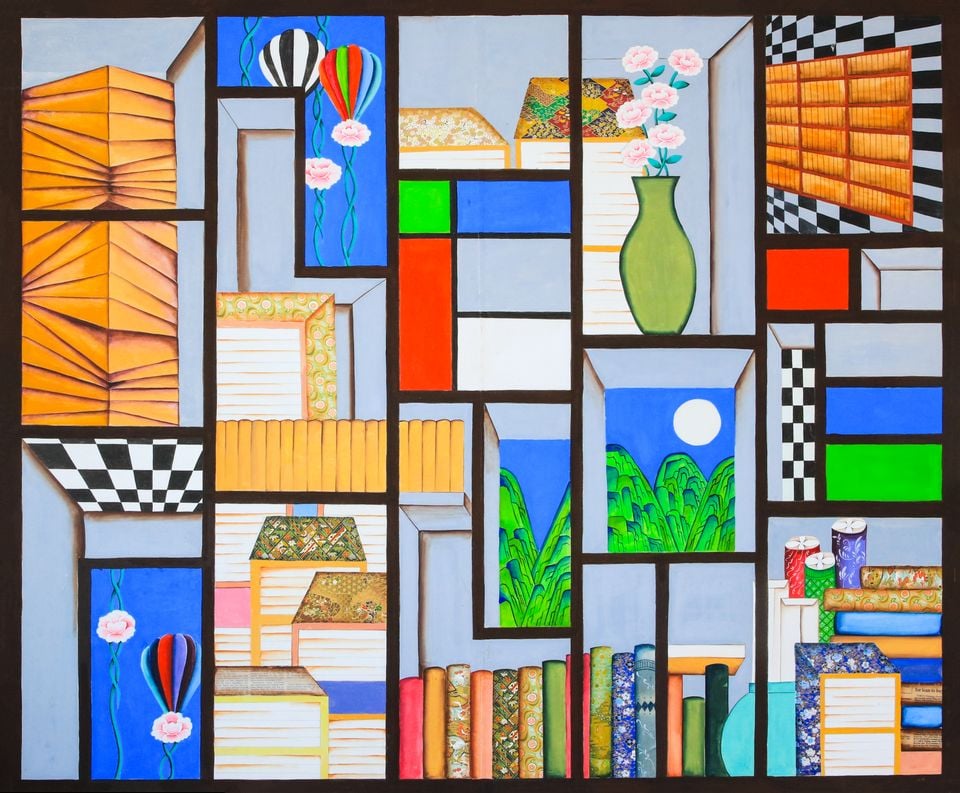
이 작품은 손유경 작가의 책거리이다. 손유경 작가의 책거리 그림을 보면 혁신이란 단어가 먼저 떠 오르게 한다. 손유경 작가의 책거리에는 몬드리안이 있고, 일원 오봉도가 있고, 세잔이 보인다. 애드벌룬 열기구를 타고 하늘을 나는 샤갈과 같은 현대적 꿈과 희망이 있으며, 현대 감각의 화려한 색상의 책들과 손유경 작가의 꽃비 그림들이 책장을 장식하고 있다. 이렇듯 손유경 작가는 책거리를 기존의 틀을 깨며 현대 감각에 맞게 상상의 날래를 달아 그렸다. 손유경 작가의 책거리는 이렇듯 작가의 상상력과 재해석을 통해 현대적 감각과 감성에 맞게 그린 것으로 장구한 기한 동안 전해오는 민화(책거리)의 틀을 깨는 변신이 놀라운 작품인 것이다.
손유경 작가는 홍익대 대학원에서 동양화를 공부한 동양화 중견화가이다. 한얼우리그림협회의 회장을 맡고 있으며 , 국내외의 많은 전시/기획전을 개최하고 있기도 하다.
Reinterpreting Chaekgeori – Son Yu-kyung
Minhwa (民畵), or Korean folk painting, is truly our painting. Rather than depicting everyday objects exactly as they appear, Minhwa expresses our collective hopes and wishes—especially the desire for blessings and longevity, known as byeoksajingyeong (辟邪進慶), the warding off of evil and the welcoming of good fortune. It is an art form that honestly and naturally reflects faith, daily life, and the heartfelt wish to beautify one’s surroundings. As such, Minhwa can be defined as a popular and practical form of art created according to the traditional customs and ways of life passed down within a community or by individuals, making it a genuine product of traditional society.
Minhwa is also an imaginative visual expression born of a very primal question: “How can we eat well, sleep well, and live well?” Its frank and even overt representation of human desires—and the vicarious satisfaction of those desires—makes it all the more fascinating. In the past, paintings often included peacock feathers, symbolizing appointment to government office, or apricot blossoms, representing success in the state civil service examination, reflecting aspirations for social advancement. The heavenly peach, said in legend to bloom and bear fruit once every three thousand years, was painted to pray for longevity, while pomegranates, filled with countless seeds, symbolized the wish for fertility and abundance.
In Minhwa, eggplants, chili peppers, and bamboo shoots symbolize masculinity, while watermelons and melons represent femininity. During times when books were rare and precious, Chaekgeori—still-life paintings of bookshelves filled with books and scholarly objects—served as symbols of wealth and learning, offering ordinary people a form of vicarious fulfillment in their longing to become learned scholars. These Chaekgeori paintings often included vases symbolizing peace, incense burners representing the burning away of worldly delusions in the pursuit of learning, and folding fans signifying prosperity and growth.
Today, Minhwa—including Chaekgeori—has begun to attract renewed attention. Once dismissed as a lesser form of art, Minhwa is now being re-evaluated and newly appreciated for its distinctive formal beauty. From an artistic and technical perspective, Minhwa is characterized by its multi-perspective composition, in which objects are depicted from different viewpoints depending on the viewer’s position. For instance, within a single painting, a vase may be shown from above, while fruit is depicted from below. This approach, known as multiple viewpoints, is one of the very reasons Paul Cézanne’s still lifes are regarded as revolutionary, as they paved the way for Cubism and abstraction. Seen in this light, the artistic excellence of Minhwa becomes all the more evident.
However, many traditional Chaekgeori paintings follow similar patterns, depict a fixed set of objects, and rely on formulaic compositions, making it difficult to perceive strong individuality or distinction among them. For this reason, Chaekgeori has at times been criticized as old-fashioned. In other words, change and innovation are needed. Just as modern art thrives on bold personal interpretation, Chaekgeori Minhwa must also break away from convention and embrace freer, more experimental techniques.
This work is a Chaekgeori painting by artist Son Yu-kyung. At first glance, the word “innovation” comes to mind. In Son Yu-kyung’s Chaekgeori, one can see echoes of Mondrian, Il-wol Obongdo, and Cézanne. There are modern dreams and hopes reminiscent of Marc Chagall, floating freely through the sky in air balloons. Contemporary, vividly colored books and the artist’s signature “flower rain” motifs adorn the shelves. In this way, Son Yu-kyung reimagines Chaekgeori by breaking free from traditional frameworks and infusing it with imagination suited to modern sensibilities. Through the artist’s creative reinterpretation, these Chaekgeori works undergo a remarkable transformation, boldly transcending the long-established conventions of Minhwa.
Son Yu-kyung is a mid-career Korean ink-and-color painter who studied Oriental painting at the graduate school of Hongik University. She currently serves as president of the Haneol Uri Painting Association and has organized and participated in numerous exhibitions and curated shows both in Korea and abroad.
