



[토마스의 그림이야기 37] 통천문암_ 작가 미상
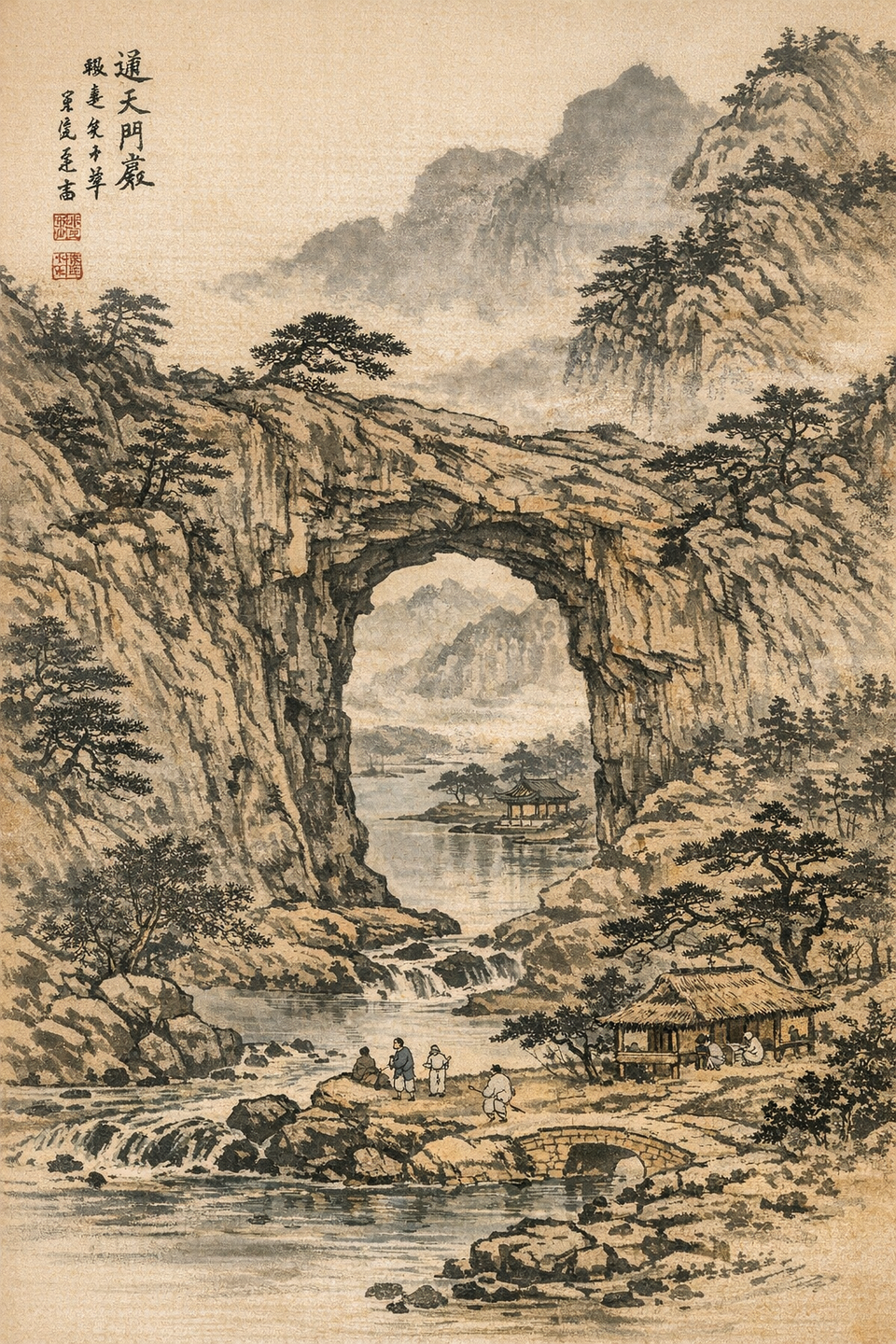
이 작품은 정선의 통천문을 모본으로 한 후대 화가의 작품이다. 겸재 정선(鄭敾, 1676–1759)의 〈통천문암도〉의 도상을 따르고 있으나 필선의 긴장감, 바위 준법의 힘, 공간 압축 방식 등에서 정선 진작(眞作) 특유의 필력에는 미치지 않는 점이 보이기도 한다.
조선 후기 ~ 대한제국기 추정 (18세기 후반~19세기)되며, 종이에 수묵담채로 그려진 이 작품의 작가는 알려져 있지 않다.
원작 통천문암은 겸재 정선이 실제 금강산의 절경을 직접 보고 그린 작품으로, 중국의 관념적 산수에서 벗어나 우리 땅을 우리 시선으로 그린 진경산수화의 정신을 분명히 보여주는 작품이다. 통천(通天)문’은 말 그대로 하늘로 통하는 문을 말하는데, 현실과 이상을 잇는 정신적인 문을 의미하며 유교적 해석으로는 자연 속에서 도(道)와 이치에 도달하는 통로를 말하며, 불교, 도교적 해석으로는 인간 세계와 초월 세계의 경계를 뜻한다.
겸재 정선은 통천문암을 통해 금강산 통천문의 단순한 경치가 아니라 깎아지른 절벽, 위로 열리는 하늘의 문을 압도적인 공간감으로 표현해 냈다. 그림의 시점을 관람자가 통천문 앞에 서 있는 현장감을 갖도록 했고 산 자체가 배경이 아니라 그림의 주체가 되도록 표현했다.
거칠고 각진 금강산 특유의 암벽 질감을 살리가 위해 먹의 농담을 조절하여 바위의 무게와 기세를 표현했는데, 이는 부드럽고 이상화되고 또한 정형화된 중국 산수화와 대비되는 것으로, 이는 조선 산수화의 독자적인 조형언어를 확립한 사례이다.
다시 말해 겸재 정선의 '통천문암'은 정선이 단순한 개인감정으로 그린 풍경화가 아니라 조선 지식인 사회가 공유하고 있던 우리 산하에 대한 자부심과 정체성을 드러낸 작품으로, 단순한 자연을 그린 것이 아니라 조선인이 세계를 바라보는 시선을 완성한 그림인 것이다.
정선의 대표 그림 중 하나인 '인왕제색도'와 비교해 보면 통천문암은 자연을 사유의 공간으로 제시하며 인간은 작고 자연은 넓고 크다는 것을 보여주며 초월의 시셰로 들어가는 정신적 이상의 도달을 그렸다면, 인왕제색도는 자연의 순간을 포팍한 것으로 비, 구름, 바위의 움직임과 변화를 순간적으로 잡아낸, 자연은 살아 움직이는 생명체임을 표현한 작품이다.
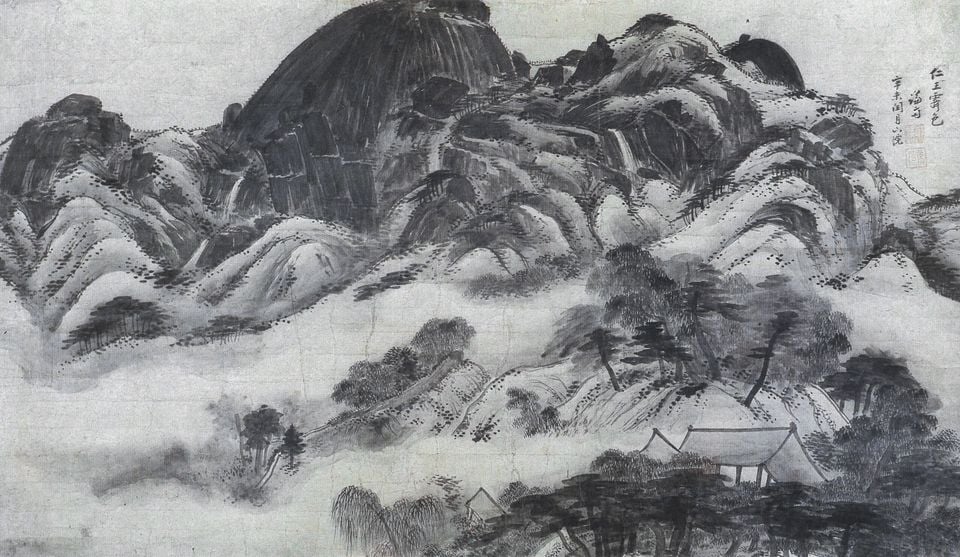
통천문암이 들어가나는 공간이라면 인왕제색도는 쏟아져 나오는 공간으로 통천문암에서는 인간이 자연 속엣 길을 찾는 존재라면, 인왕제색도에서는 인간은 자연 앞에서 압도되는 존재임을 나타내고 있다. 이를 요약해 보면 두 작품 모두 실제의 지연을 모델로 한 진경산수화이지만 통천문암은 정신적, 철학적 개념을 토대로 한 것이고, 인왕제색도는 철학이 도달한 기술적 표현의 정점을 이루는 작품이라 하겠다.
Tongcheonmunam (Rock of the Gate to Heaven)
This work is by a later painter who took Jeong Seon’s Tongcheonmunam as a model. While it follows the iconography of Tongcheonmunam-do by Gyeomjae Jeong Seon (1676–1759), it falls short of the distinctive power of Jeong Seon’s authentic works, particularly in the tension of the brushwork, the strength of the rock texture (junbeop), and the method of spatial compression.
The painting is presumed to date from the late Joseon period to the Korean Empire period (late 18th to 19th century). Executed in ink and light color on paper, the artist remains unknown.
The original Tongcheonmunam by Gyeomjae Jeong Seon was based on his direct observation of the spectacular scenery of Mount Geumgang. Departing from the idealized and conceptual landscape traditions of China, it clearly embodies the spirit of true-view landscape painting (jingyeong sansuhwa), depicting Korea’s land from a distinctly Korean perspective. The term “Tongcheon” (通天, “Passage to Heaven”) literally means a gate that connects to the heavens. Symbolically, it represents a spiritual gateway linking reality and the ideal: in Confucian interpretation, a path to attaining the Way (Dao) and principle (li) through nature; in Buddhist and Daoist interpretations, a boundary between the human world and the transcendent realm.
Through Tongcheonmunam, Jeong Seon expressed not merely a scenic view of the Tongcheon Gate at Mount Geumgang, but an overwhelming sense of space defined by sheer cliffs and a sky opening upward like a celestial portal. The viewpoint places the viewer as if standing directly before the Tongcheon Gate, creating a strong sense of immediacy, while the mountain itself becomes the central subject rather than a mere background.
To convey the rugged, angular rock formations characteristic of Mount Geumgang, Jeong Seon carefully modulated the density of ink, expressing both the weight and dynamic force of the cliffs. This approach contrasts sharply with the softer, idealized, and formulaic conventions of Chinese landscape painting and stands as a defining example of the independent visual language developed in Joseon landscape art.
In other words, Jeong Seon’s Tongcheonmunam is not a landscape painted from personal sentiment alone. It is a work that reveals the pride and cultural identity shared by Joseon intellectual society in their native land. Rather than simply depicting nature, it completes a distinctly Joseon way of seeing and understanding the world.
When compared with another of Jeong Seon’s representative works, Inwang Jesaekdo (Clearing after Rain on Mount Inwang), Tongcheonmunam presents nature as a space for contemplation. It emphasizes the smallness of humanity against the vastness of nature and depicts a spiritual ascent toward transcendence. In contrast, Inwang Jesaekdo captures a fleeting moment in nature, rendering the movement and transformation of rain, clouds, and rocks, and portraying nature as a living, breathing organism.
If Tongcheonmunam represents a space one enters, Inwang Jesaekdo represents a space that bursts forth. In Tongcheonmunam, humans are beings who seek a path within nature, whereas in Inwang Jesaekdo, humans are overwhelmed by the power of nature itself. In summary, while both works are true-view landscapes based on real sites, Tongcheonmunam is grounded in spiritual and philosophical concepts, whereas Inwang Jesaekdo represents the pinnacle of technical expression achieved after philosophical insight has been fully realized.
