



[토마스의 그림이야기 50] 대가족 _장샤오강
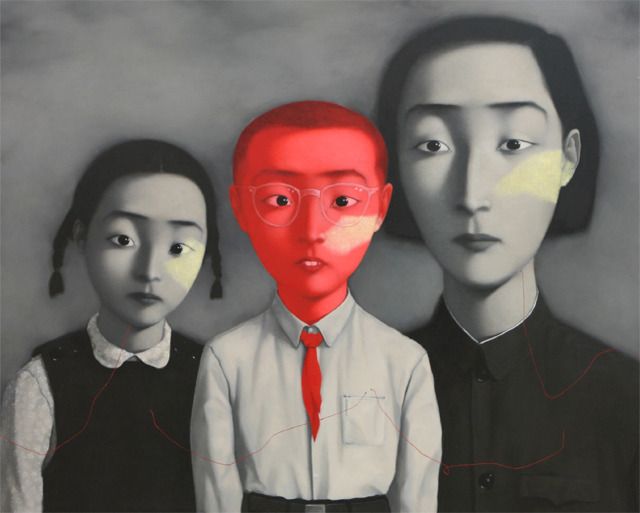
이 작품은 장샤오강(張曉剛, 1958년생)이 고향 부모님 집에서 우연히 발견한 문화대혁명 시기의 가족사진에서 영감을 얻어 제작한 '혈통' 시리즈 중 '대가족'이다. 마오쩌둥(毛澤東)이 주도한 문화혁명은 기존의 모든 전통과 가치를 뿌리째 흔들었고, 마오의 친위대였던 학생 홍위병들은 아버지뻘인 공산당 간부, 지식인, 교사들을 공개적으로 처형하는 데 앞장섰다. 혁명은 수백만 명의 숙청과 억울한 희생을 낳은 후에야 끝이 났고, 그 상처는 결국 중국인 모두에게 남았다.
장샤오강은 현대 중국의 상징주의 및 초현실주의 화가이다. 그의 '혈통(Bloodline) 시리즈'는 주로 흑백의 양식화된 중국인 초상화로, 인물들을 대개 크고 짙은 눈동자를 가지고 있는데, 1950년대와 1960년대의 가족 초상화를 의도적으로 연상시키는 뻣뻣한 자세를 취하고 있다.
장샤오강의 '혈통' 시리즈는 개인의 기억과 국가의 집단적 역사, 그리고 가족이라는 제도를 통해 중국 현대사의 트라우마와 정체성 문제를 시각화한 것으로 문화대혁명 시기의 가족사진과 선전 이미지에서 영감을 받아, 획일화된 얼굴과 정면을 응시하는 인물들을 반복적으로 그렸다.
장샤오강의 '혈통' 시리즈의 특징을 살펴보면 가족사진 형식을 빌려 1950~70년대 중국의 흑백 가족사진을 연상시키는 구도의 인물들은 단정한 자세로 정면을 응시하며 감정을 드러내지 않으며, 그의 그림에 등장하는 인물들은 개인의 감정과 개성이 억압된 상태를 상징하는, 사회주의 체제 속 ‘의 ‘집단 인간’의 초상을 암시하는 창백한하고 무표정한 얼굴을 하고 있다.
인물의 얼굴이나 몸을 가로지르는 붉은 실선으로 그리는 데 이는 혈연, 유전, 이데올로기, 운명적 연결을 동시에 의미하며, 개인이 벗어날 수 없는 역사적·사회적 굴레를 나타낸다. 또한 미세한 결함, 번짐, 얼룩, 색의 어긋남으로 완벽한 집단 이미지 속에 남아 있는 개인의 상처와 불안을 표현하고 있다.
장샤오강은 문화대혁명(1966~1976) 시기의 경험을 바탕으로, 가족이 사적인 공간이 아닌 정치적 단위였던 시대, 개인보다 혈통·계급·출신이 더 중요했던 현실을 은유적으로 드러내고 있는데, 이 시리즈는 단순한 가족 초상이 아니라, “개인은 누구이며, 집단 속에서 나는 어디에 존재하는가?”라는 질문을 던지고 있다.
장샤오강의 회화는 “중국 현대사의 초상화가”라는 평가를 받으며, 특히 '혈통' 시리즈는 가족의 얼굴을 빌려, 개인이 지워진 시대의 집단 기억과 보이지 않는 상처를 그린 초상화이기도 하다.
Big Family from the Bloodline series
This work is Big Family from the Bloodline series by Zhang Xiaogang (張曉剛, b. 1958), inspired by a family photograph from the Cultural Revolution period that the artist happened to discover at his parents’ home in his hometown. The Cultural Revolution, led by Mao Zedong, violently uprooted existing traditions and values. Student Red Guards—Mao’s paramilitary supporters—took the lead in publicly persecuting and executing Communist Party officials, intellectuals, and teachers who were often of their parents’ generation. The movement came to an end only after millions were purged or unjustly victimized, leaving deep and lasting scars on the Chinese people as a whole.
Zhang Xiaogang is a leading contemporary Chinese painter associated with symbolism and surrealism. His Bloodline series consists primarily of stylized, black-and-white portraits of Chinese figures, often characterized by large, dark eyes and stiff, formal poses that deliberately recall family portraits from the 1950s and 1960s.
Through the institution of the family, personal memory, and collective national history, the Bloodline series visualizes the trauma and identity crisis of modern Chinese history. Drawing inspiration from family photographs and propaganda images of the Cultural Revolution era, Zhang repeatedly depicts standardized faces and figures staring directly at the viewer.
A defining feature of the series is its use of the family-photo format: the compositions evoke black-and-white family portraits from the 1950s to the 1970s, with figures seated or standing upright, facing forward, and withholding all visible emotion. The pale, expressionless faces suggest the suppression of individuality and emotion, presenting an image of the “collective human being” shaped by the socialist system.
The thin red line that crosses the faces or bodies of the figures simultaneously signifies blood ties, heredity, ideology, and a sense of inescapable destiny. It represents the historical and social constraints from which the individual cannot escape. Subtle flaws—such as smudges, stains, blurs, and slight color dislocations—further convey the lingering wounds and anxieties of the individual hidden beneath an apparently flawless collective image.
Grounded in his own experience of the Cultural Revolution (1966–1976), Zhang metaphorically reveals a time when the family functioned not as a private space but as a political unit, and when bloodline, class, and background mattered more than the individual. The Bloodline series is therefore not merely a set of family portraits, but a profound inquiry into the question: Who is the individual, and where does one exist within the collective?
Zhang Xiaogang’s paintings have earned him the reputation of being a “portraitist of modern Chinese history.” In particular, the Bloodline series uses the faces of families to portray collective memory and invisible wounds from an era in which individuality was erased.
