



[토마스의 그림이야기 58] 삼릉비경 _박대성
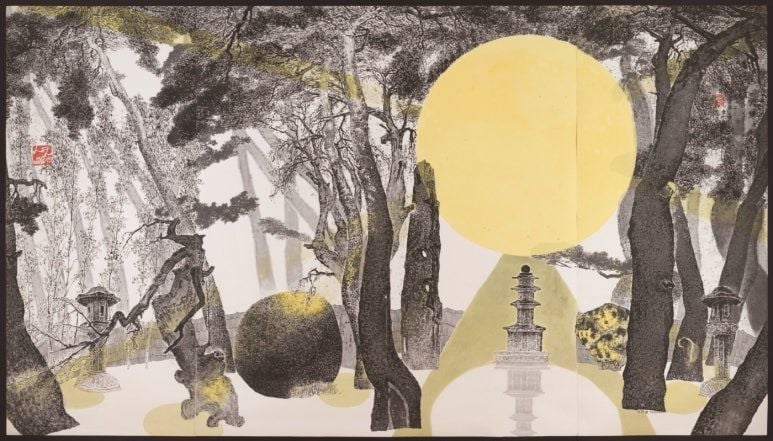
이 작품은 국내 진경산수화의 맥을 잇고, 전통에 머물러 있던 한국 수묵화를 현대적으로 재해석했다는 평가를 받는 한국 수묵화의 거장 박대성 화백의 〈삼릉비경(三陵秘境)〉이다.
이 작품은 박대성이 경주의 자연과 신라의 역사성을 주제로 그린 대표적인 풍경화 가운데 하나로, 배경은 경주 삼릉 일대로 알려져 있다. 삼릉은 경주 남산 서쪽 기슭에 자리한 세 개의 신라 왕릉을 말한다. 이들 왕릉은 서로 가까운 거리에 위치하며 일반적으로 아달라 이사금 능, 신덕왕 능, 그리고 경명왕 능으로 추정된다. 삼릉은 신라 왕릉 가운데 비교적 초기 양식의 봉분을 보여주며, 흙을 둥글게 쌓은 단순한 원형 봉분과 화려한 석물 장식이 거의 없는 점, 그리고 자연 지형과 조화를 이루는 배치가 특징이다.
삼릉 일대는 울창한 소나무 숲과 완만한 산세가 어우러진 아름다운 자연 경관으로도 유명하다. 특히 안개가 끼는 새벽이나 달이 떠 있는 밤 풍경은 신비로운 분위기를 자아내어 오래전부터 많은 화가와 사진가들의 창작 소재가 되어 왔다.
신라 천년의 역사와 자연의 장엄함을 동시에 표현한 이 작품은 박대성 특유의 대형 수묵 화풍이 잘 드러난다. 굵고 힘찬 붓질과 깊은 먹의 농담을 통해 산과 숲의 기운을 표현하고 있으며, 둥근 능선의 왕릉과 오래된 소나무, 안개 낀 산세는 자연 풍경을 넘어 성스러운 역사 공간으로서 신라 천년의 시간성을 상징적으로 보여 준다. 또한 화면 전체에 흐르는 여백과 먹의 흐름은 자연의 기(氣)와 생동하는 흐름을 강조하며 동양적 미감을 깊이 있게 드러낸다.
박대성은 전통 수묵을 기반으로 한국 수묵화를 현대적 스케일로 확장해 온 작가로, 경주와 남산의 풍경을 주요 주제로 작업해 왔다. 그는 자연을 단순한 풍경이 아니라 역사와 정신이 깃든 공간으로 해석하며, 작품을 통해 한국적 자연관과 정신성을 표현하고 있다. 이러한 이유로 그의 작품 세계는 종종 “현대 수묵의 장대한 산수”라는 평가를 받는다.
1945년 일본 오사카에서 태어난 그는 어린 시절 한국으로 돌아와 성장하였다. 전쟁과 가난 속에서 성장했으며, 사고로 한쪽 팔을 잃는 큰 시련을 겪었지만 이를 극복하고 독학에 가까운 노력으로 화가의 길을 걸어왔다. 그의 작품에서 두드러지는 특징은 압도적인 규모의 수묵화로, 수 미터에 이르는 대형 화면 위에 산과 숲, 자연의 기운을 강렬한 붓질로 표현하는 데 있다.
박대성의 작품은 전통을 계승하면서도 현대적으로 확장했다는 평가를 받는다. 특히 **겸재 정선**의 진경산수 정신과 동양 수묵 특유의 여백과 기운, 그리고 현대적 구성과 대형 화면이라는 특징이 그의 작품 세계에서 조화를 이루고 있다.
Samneung Bigyeong (Secret Landscape of the Three Royal Tombs) by Park Dae-Sung
This work, Samneung Bigyeong (三陵秘境, Secret Landscape of the Three Royal Tombs), is by Park Dae-Sung, a master of Korean ink painting who is recognized for continuing the tradition of true-view landscape painting in Korea while reinterpreting traditional Korean ink painting in a modern way.
The painting is one of Park Dae-Sung’s representative landscape works based on the natural scenery of Gyeongju and the historical legacy of the Silla Kingdom. The setting is known to be the area around the Samneung Royal Tombs. “Samneung” refers to the three royal tombs of the Silla dynasty located on the western foothills of Namsan Mountain. These tombs lie close to one another and are generally believed to be those of Adalla of Silla, Sindeok of Silla, and Gyeongmyeong of Silla. Among Silla royal tombs, the Samneung tombs display relatively early burial styles. They are characterized by simple circular earthen mounds, the near absence of elaborate stone sculptures, and a layout that harmonizes naturally with the surrounding terrain.
The Samneung area is also famous for its beautiful natural scenery, where dense pine forests blend with gently sloping hills. In particular, the misty dawns and moonlit night landscapes create a mysterious atmosphere, which for a long time has served as inspiration for many painters and photographers.
Expressing both the thousand-year history of Silla and the grandeur of nature, this work clearly reveals Park’s distinctive large-scale ink painting style. Through bold and vigorous brushstrokes and rich gradations of ink, the artist conveys the vitality of mountains and forests. The rounded forms of the royal tombs, ancient pine trees, and mist-covered ridges transcend a mere landscape, symbolically presenting the thousand-year temporality of Silla as a sacred historical space. In addition, the flowing empty spaces and movements of ink across the entire composition emphasize the living energy and rhythm of nature, revealing the profound aesthetic sensibility of East Asian art.
Grounded in the tradition of ink painting, Park Dae-Sung has expanded Korean ink painting into a modern scale. He has long focused on the landscapes of Gyeongju and Namsan, interpreting nature not simply as scenery but as a space imbued with history and spiritual meaning. For this reason, his artistic world is often described as representing the “grand landscape of modern ink painting.”
Born in Osaka, Japan, in 1945, he returned to Korea during childhood and grew up there. He endured the hardships of war and poverty, and also suffered a serious accident that resulted in the loss of one arm. Nevertheless, he overcame these challenges and pursued the path of an artist through efforts that were largely self-taught. A striking characteristic of his work is the overwhelming scale of his ink paintings, in which powerful brushwork expresses the energy of mountains, forests, and nature across canvases that often span several meters.
Park Dae-Sung’s works are regarded as both inheriting tradition and expanding it in a modern direction. In particular, the spirit of true-view landscape painting associated with Jeong Seon, together with the distinctive sense of emptiness and energy characteristic of East Asian ink painting, as well as modern compositional structures and monumental scale, are harmoniously integrated in his artistic world.
