



[토마스의 그림이야기 57] 기도하는 소녀 _ 김흥수
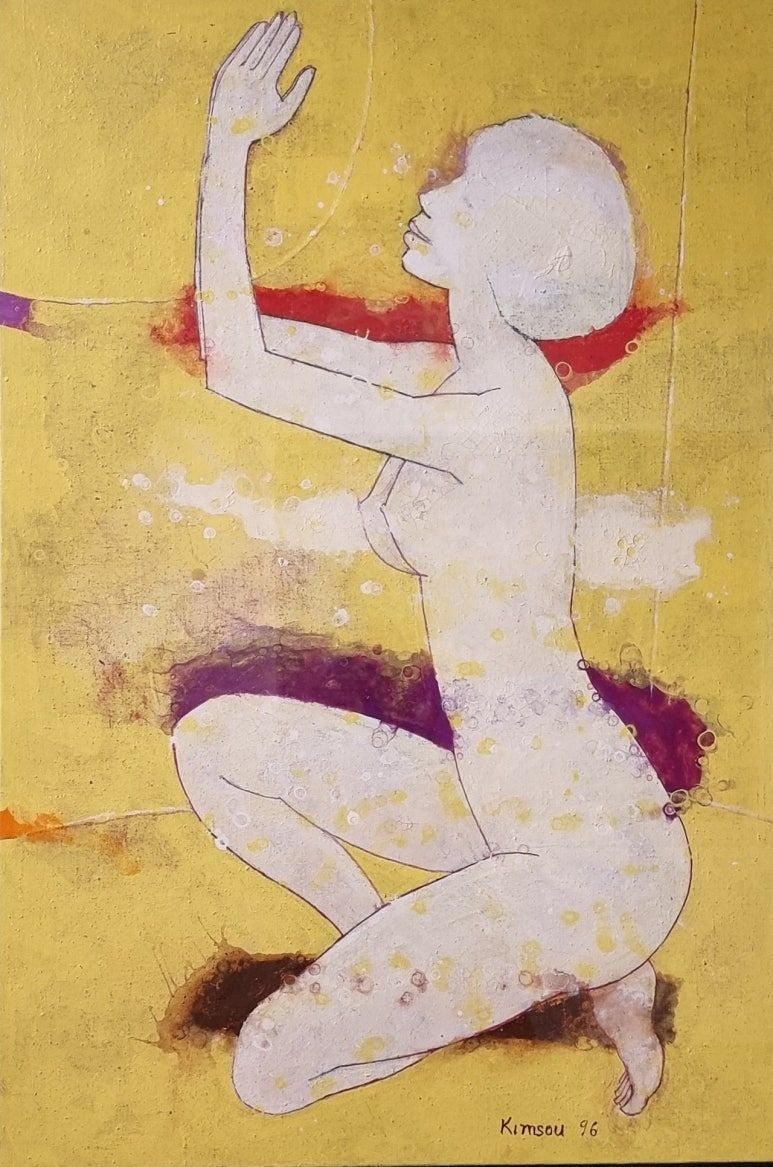
김흥수(金興洙, 1919–2014)의 〈기도하는 소녀〉는 그의 예술 세계, 특히 하모니즘(Harmonism)으로 나아가기 직전의 사유와 그 핵심을 이해하는 데 매우 중요한 작품이다. 이 작품은 ‘영성(기도)’과 ‘누드’의 결합이라는 한국 현대미술에서 보기 드문 사례로, 서구 누드 미술의 관능적 전통에서 벗어나 존재론적 누드로 나아간 의미 있는 전환점을 보여준다. 더 나아가 김흥수 예술 인생 전체를 관통하는 이성(구조)과 감성(육체)의 화해를 예고하는 작품이라 할 수 있다.
김흥수 화백은 1919년 함흥에서 태어나 동경미술학교에서 유화를 전공하였다. 그의 예술에서 음양의 원리는 단순한 조형적 대비에 머무르지 않고, 기쁨과 슬픔, 사랑과 미움 등 인간의 감정과 정서 전반을 포괄하는 개념으로 확장된다. 구상과 추상이 하나의 화면 안에서 완결된 조화를 이루는 그의 독창적 회화 세계는 이러한 철학적 기반 위에서 형성되었으며, 이로 인해 그는 종종 ‘한국의 피카소’로 불리기도 한다.
김흥수는 누드에 대해 다음과 같이 말한 바 있다.
“나는 일생 동안 누드를 많이 그렸지만, 그것은 단순히 여인의 피부, 누드의 표피만을 그린 것이 아니다. 인간으로서의 누드, 즉 희로애락을 가진 여인의 절실한 감정을 그린 것이다. 그래서 내 그림은 인생철학을 담고 있다고 감히 말한다.”
이 고백은 〈기도하는 소녀〉를 이해하는 핵심 열쇠다. 이 작품의 누드는 관능의 대상이 아니라, 한 인간이 지닌 환희와 절망, 허무와 끝없는 욕망이 응축된 존재로 제시된다.형식적으로 〈기도하는 소녀〉는 비교적 사실적인 인체 묘사를 바탕으로, 색면의 단순화와 선의 절제, 그리고 화면 전반에 흐르는 이중 구조가 두드러진다. 화면의 한쪽은 구상에 머무르고, 다른 한쪽은 이미 추상으로 향하는 긴장감을 내포하며, 이는 이후 김흥수 회화의 핵심이 되는 이중 회화 언어의 태동을 보여준다.
특히 이 작품에서 여성의 육체는 욕망이나 시각적 소비의 대상이 아닌, 하나의 고귀한 ‘존재’로 그려진다. 관능적 시선은 의도적으로 배제되며, 몸은 부드럽되 과장되지 않고, 자세는 정적이며 내면으로 침잠한다. 인물의 시선 또한 관객을 향하지 않고 자기 자신의 내면을 응시함으로써, 누드를 소유의 대상이 아닌 성찰의 매개로 전환시킨다.
결국 〈기도하는 소녀〉는 김흥수가 누드를 통해 욕망을 그린 작품이 아니라, 욕망을 넘어서는 ‘존재의 균형’을 그린 작품이라 할 수 있다. 이는 곧 하모니즘으로 귀결되는 그의 예술 세계를 미리 예시하는 중요한 출발점이다.
Praying Girl by Kim Heung-soo (1919–2014)
Praying Girl by Kim Heung-soo (1919–2014) is a highly significant work for understanding his artistic universe, particularly the period immediately preceding his formulation of Harmonism, as well as the core principles that would come to define it. The painting represents a rare example in Korean modern art of the fusion of spirituality (prayer) and the nude, marking a meaningful turning point away from the sensual traditions of Western nude painting toward an ontological interpretation of the nude. Moreover, it may be regarded as a work that foreshadows the reconciliation of reason (structure) and emotion (the body)—a dialectic that runs throughout Kim Heung-soo’s entire artistic career.
Kim Heung-soo was born in 1919 in Hamhung and studied oil painting at the Tokyo School of Fine Arts. In his art, the principle of yin and yang is not limited to formal or visual contrast; rather, it expands to encompass the full spectrum of human emotions and sensibilities, including joy and sorrow, love and hatred. His distinctive pictorial language—where figuration and abstraction are brought into complete harmony within a single canvas—was formed upon this philosophical foundation, earning him the epithet “the Picasso of Korea.”
Regarding the nude, Kim Heung-soo once stated:
“Throughout my life, I painted many nudes, but they were not merely depictions of a woman’s skin, the surface of the nude. I painted the nude as a human being—that is, the earnest emotions of a woman who possesses joy, anger, sorrow, and pleasure. Therefore, I dare say that my paintings contain a philosophy of life.”
This confession serves as a key to understanding Praying Girl. The nude in this work is not presented as an object of sensual desire, but as an existence in which elation and despair, emptiness and endless longing are condensed.
Formally, Praying Girl is characterized by a relatively realistic rendering of the human body, combined with simplified color planes, restrained lines, and a pervasive dual structure across the pictorial surface. One side remains grounded in figuration, while the other already inclines toward abstraction, generating a palpable tension. This compositional strategy signals the emergence of Kim Heung-soo’s distinctive dual pictorial language, which would later become central to his work.
Most notably, the female body in this painting is depicted not as an object of desire or visual consumption, but as a noble “being” in its own right. Sensuality is deliberately withheld; the body is rendered softly yet without exaggeration, the posture is still and introspective, and the figure’s gaze is directed inward rather than toward the viewer. In doing so, the nude is transformed from an object of possession into a medium for contemplation.
Ultimately, Praying Girl is not a work in which Kim Heung-soo depicts desire through the nude, but one in which he paints a balance of existence that transcends desire. As such, it stands as an important point of departure that anticipates the full realization of Harmonism, the philosophical and aesthetic culmination of his artistic vision.
