



[토마스의 그림이야기 60] 싸우는 소 _ 이중섭
이 작품 〈싸우는 소〉는 한국 근현대 미술을 대표하는 화가 이중섭(李仲燮, 1916~1956)의 소 그림 가운데 하나로, 그의 대표작인 〈황소〉 계열 작품으로 알려져 있다. 이중섭은 평생 ‘소’를 주요 화제로 삼아 한국인의 삶과 정신을 상징적으로 표현하였다.
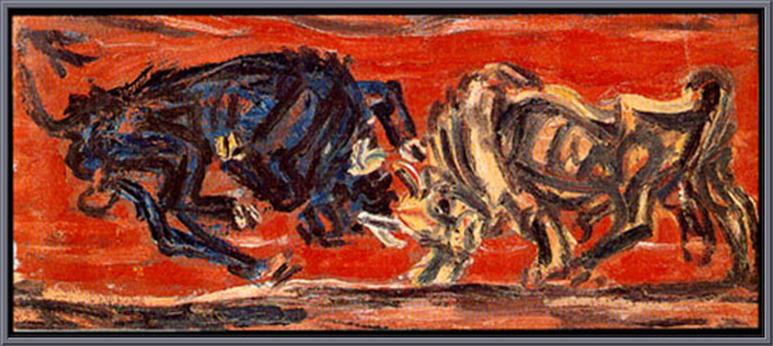
그림에는 서로 마주하며 긴장감 있게 맞서는 두 마리의 소가 등장한다. 왼쪽의 짙은 푸른색 소는 몸을 낮추고 앞으로 돌진하려는 자세를 취하고 있으며, 오른쪽의 황갈색 소는 몸을 크게 세우고 이에 맞서는 모습을 보인다. 이러한 장면은 단순한 동물의 싸움이라기보다 힘과 생명력, 그리고 투쟁의 에너지를 상징적으로 표현한 것으로 해석된다.
소싸움의 유래는 경남 일대에서 봄부터 여름까지 소를 먹이던 목동들이 힘센 소를 가려내기 위해 서로 싸움을 붙이던 놀이에서 비롯된 것으로 전해진다. 이는 농경문화가 정착된 사회에서 목동들이 망중한을 즐기기 위한 즉흥적인 놀이로 시작되었으나, 점차 그 규모가 커지면서 마을 단위의 대항 경기로 발전하였다. 이후 부락이나 씨족 단위로 확산되어 서로의 명예를 걸고 가세(家勢)나 족세(族勢)를 과시하는 장이 되기도 했다. 그러나 일제강점기에는 민족적 단합을 억제하려는 정책으로 인해 이러한 전통이 폐지되었고, 광복 이후 다시 부활하였다.
이처럼 〈싸우는 소〉는 단순한 풍속적 장면을 넘어 당시의 현실을 상징적으로 반영한다. 서로 맞서는 두 마리의 소는 분단된 조국의 현실과 가족과의 이별이라는 작가 개인의 비극적 상황을 은유적으로 드러내는 존재로 해석되기도 한다.
이중섭의 소는 흔히 한국 민중의 강인함, 삶의 고통과 인내, 그리고 억압을 견디는 생명력을 상징한다. 이 그림에서 가장 강렬한 요소는 붉은 배경이다. 붉은 색채는 화면 전체에 격렬한 감정과 긴장감을 극대화하며, 거칠고 빠른 선으로 표현된 소의 형태는 폭발적인 에너지를 전달한다. 특히 검은 윤곽선과 강한 붓질은 표현주의적인 특징을 잘 보여 준다. 이러한 표현 방식은 일본 유학 시절 영향을 받은 빈센트 반 고흐의 강렬한 붓질과도 비교되곤 한다.
이중섭의 작품 세계는 그의 비극적인 삶과 깊이 연결되어 있다. 한국전쟁으로 인한 가족과의 생이별, 가난과 외로움 속에서 이어진 창작 활동, 그리고 40세의 짧은 생애는 그의 예술 세계에 깊은 흔적을 남겼다. 그에게 소는 단순한 동물이 아니라 자신의 분신이자 민족의 상징이었다.
이중섭의 소 그림은 한국 미술사에서 매우 중요한 위치를 차지한다. 한국적 정서를 가장 강렬하게 표현한 회화이자, 전통적 상징과 현대적 표현주의가 결합된 대표적 사례이기 때문이다. 특히 이 작품 〈싸우는 소〉는 1954년 가족이 일본으로 떠난 뒤 홀로 지내던 시기에 제작된 것으로 알려져 있다. 두 마리의 소가 머리를 맞대고 대립하는 구도를 통해 생명의 힘과 한국인의 강인한 정신을 강렬하게 드러낸다.
이중섭에게 삶의 경험은 곧 예술의 근원이 되었다. 개인의 인격 형성은 가정환경과 시대정신, 사회문화적 조건의 영향을 받기 마련이다. 그는 예술을 통해 자신의 내면에서 치열하게 일어나는 갈등과 질문을 표현하였다. 자식의 죽음, 가족과의 이별, 전쟁으로 인한 좌절과 같은 트라우마는 그의 작품 곳곳에 깊이 새겨져 있다. 특히 〈싸우는 소〉는 이러한 작가의 심경이 상징적으로 드러난 작품 가운데 하나라 할 수 있다.
Fighting Bulls by Lee Jung-seob
This work, 〈Fighting Bulls〉, is one of the bull paintings by the Korean modern artist Lee Jung-seob (1916–1956), and is known as part of the series related to his representative work 〈Bull〉. Throughout his life, Lee frequently used the motif of the bull as a central subject, symbolically expressing the life and spirit of the Korean people.
The painting depicts two bulls facing each other in a tense confrontation. The dark blue bull on the left lowers its body as if preparing to charge forward, while the yellowish-brown bull on the right stands firmly, confronting its opponent. This scene can be interpreted not simply as a depiction of animals fighting, but as a symbolic representation of strength, vitality, and the energy of struggle.
The origin of traditional Korean bullfighting is said to trace back to the Gyeongsangnam-do region, where young cowherds who tended cattle from spring through summer would pit strong bulls against one another as a pastime. What began as a spontaneous form of entertainment for herders during moments of leisure gradually expanded into competitions between villages. Over time, the practice spread to the level of clans or local communities, where it became a venue for displaying honor and prestige, often reflecting the wealth or influence of a family or lineage. However, during the Japanese colonial period, such traditions were suppressed as part of policies intended to weaken Korean social unity. After Korea’s liberation, the tradition was revived.
In this sense, 〈Fighting Bulls〉 transcends a simple depiction of rural custom and symbolically reflects the realities of its time. The two opposing bulls can also be interpreted as metaphors for the divided nation and for the artist’s own tragic experience of separation from his family.
In Lee Jung-seob’s work, the bull often symbolizes the resilience of the Korean people, the endurance of suffering, and the vitality that persists despite oppression. One of the most striking elements of this painting is the red background. The intense red color amplifies the emotional tension across the canvas, while the roughly drawn forms of the bulls, rendered with rapid and forceful lines, convey explosive energy. The bold black outlines and vigorous brushstrokes clearly reveal expressionistic characteristics. This expressive manner is sometimes compared to the powerful brushwork of Vincent van Gogh, whose work influenced Lee during his period of study in Japan.
Lee Jung-seob’s artistic world is deeply intertwined with his tragic life. The separation from his family during the Korean War, his years of poverty and loneliness, and his short life—he died at the age of forty—left profound marks on his art. For Lee, the bull was not merely an animal but rather an alter ego and a symbol of the Korean people.
Lee Jung-seob’s bull paintings occupy an important place in Korean art history. They represent some of the most powerful visual expressions of Korean sentiment while combining traditional symbolism with modern expressionist techniques. In particular, 〈Fighting Bulls〉 is believed to have been created in 1954, during the period when the artist lived alone after his family had departed for Japan. Through the composition of two bulls locking heads in confrontation, the work powerfully expresses the force of life and the resilient spirit of the Korean people.
For Lee Jung-seob, lived experience became the very foundation of his art. As with anyone, personal character is shaped by family environment, the spirit of the times, and broader social and cultural conditions. Through his art, Lee expressed the intense inner conflicts and questions that stirred within him. Traumas such as the death of his child, separation from his family, and the despair brought about by war are deeply embedded throughout his works. In particular, 〈Fighting Bulls〉 can be regarded as one of the paintings that most poignantly reflects the artist’s emotional state and inner turmoil.
